Turn the concept
into evidence.
Integrate the wearable, VR and sensing layers. Establish operating limits, repeatability and a credible validation pathway.
Milestone: documented engineering and usability evidence.
 Build it with us ↗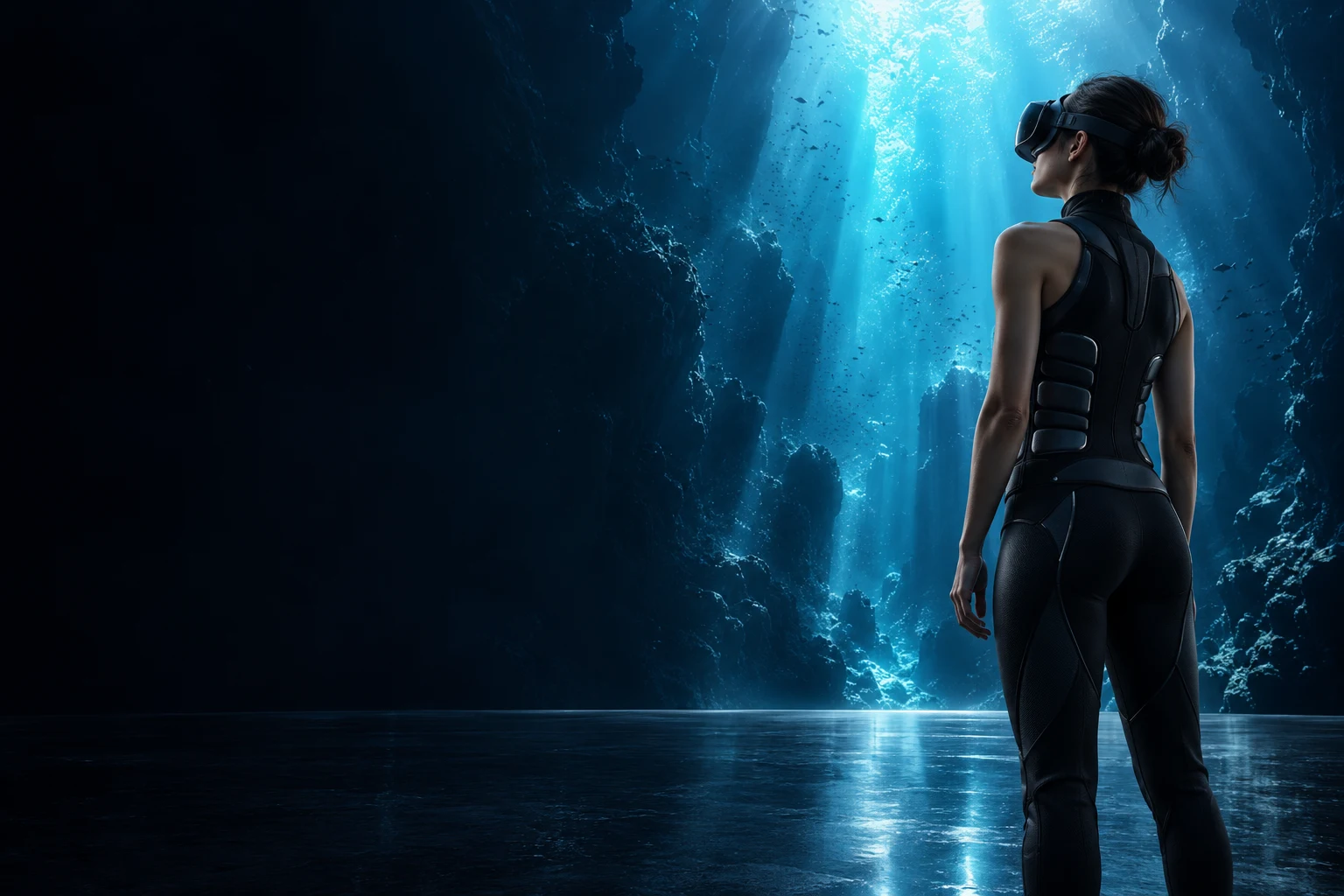
See the ocean. Feel the depth.
Explore what comes next.
The next layer of immersion
01 / Beyond the headset
ABYSS ONE is a VR diving and freediving simulator in development by Neptune’s Submerge. Our embodied simulation concept connects a virtual ocean, a depth-linked compression wearable and biometric monitoring in one controlled experience on dry land.
For trainers, a repeatable setting. For researchers, a richer question. For people, a new way to encounter the underwater world.
01 / Dive in
Move through a virtual descent.
Discover how the three layers could connect.
Visual and spatial cues introduce the ocean setting. The virtual environment establishes the starting point.
Illustrative web demo — no live biometrics or hardware control. Virtual metres do not specify physical pressure, operating limits or validated performance.
02 / Feel the future
VR establishes a controllable underwater environment, with virtual depth as a shared input.
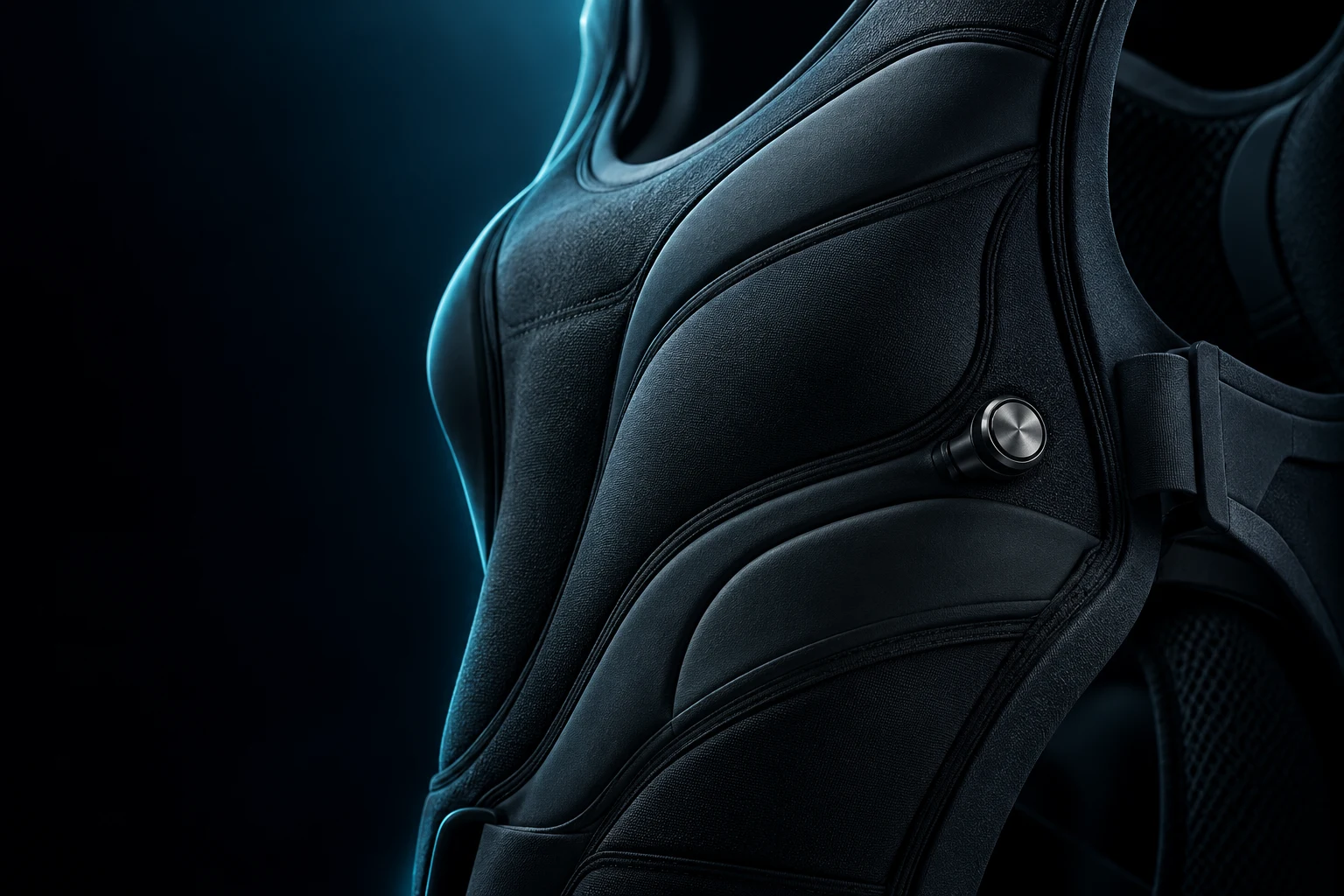
A bladder-based wearable is intended to synchronise compression cues with the virtual descent.
Biometric monitoring aims to connect session events with physiological signals for review and research.
Development stage: prototype and engineering validation. Compression cues are not equivalent to reproducing the full physiology of underwater pressure.
A focused route to market
Start where repeatable immersion matters.
Expand as evidence and partnerships grow.
Dive & maritime training
Explore supervised familiarisation and scenario repetition in a controlled setting, with a view to complementing practical instruction.
Human response & immersive research
Investigate how visual depth and physical cues relate to human response, using defined protocols and appropriately governed data.
Education & destination experiences
Explore a new format for ocean storytelling in aquariums, science centres and learning spaces — with participation designed around the visitor.
Proposed applications, subject to technical validation, suitability assessment and sector requirements. No certified training equivalence or clinical benefit is claimed.
The wider case for immersion
Independent research gives a reason to investigate. Product-specific evidence is the next step.
Faster training completion than classroom learning in PwC’s soft-skills study.
Greater focus than e-learning participants in the same study.
Learners at which VR reached classroom cost parity in that programme.
Source: PwC VR Soft Skills Training Efficacy Study (2020). Findings relate to that programme, not diving simulation or ABYSS ONE. Outcomes depend on the content, learners and delivery model.
Read the research ↗The investment & partnership thesis
The opportunity is a reusable simulation platform: a common hardware and software foundation, adapted through sector-specific content and partnerships.
Integrate the wearable, VR and sensing layers. Establish operating limits, repeatability and a credible validation pathway.
Co-design focused pilots with training, research or experience partners. Measure usefulness, delivery effort and adoption.
Explore manufacturing partnerships, institutional software licensing and tailored content as potential revenue routes.
An invention-led foundation
UK publication GB2640439A describes a VR diving system combining wearable biometric monitoring with optional compression simulation. International application: PCT/GB2025/050741.
Explore the published application ↗A company with an ocean purpose
ABYSS ONE extends our focus on immersive ocean experiences into physical simulation. Explore the company’s existing education work and documented delivery context.
Explore Neptune’s Submerge case studies ↗The ambition: selected ocean experiences and preparation in inland, institutional and community settings.
The ambition: better-informed development through session evidence, user feedback and responsible research.
Commercial routes and impact are development goals, not achieved outcomes or financial forecasts.
Questions, answered
The concept, its development stage
and how to get involved.
ABYSS ONE is Neptune’s Submerge’s working product name for an embodied diving-simulation programme. It combines an immersive virtual underwater environment with proposed depth-linked wearable compression and biometric monitoring. It is at the prototype and engineering validation stage.
The proposed system connects the visual experience to a physical compression layer and physiological signals. The development goal is to explore a measurable, repeatable experience for supervised familiarisation, research and visitor experiences, rather than visual immersion alone.
Freediving familiarisation is a proposed application for partner-led pilots. Training effectiveness and operating limits still require validation. ABYSS ONE is not presented as a replacement for qualified instruction, in-water training or recognised certification.
The concept uses wearable compression cues linked to virtual depth. These cues are not equivalent to recreating ambient underwater pressure or the full physiological effects of a real dive. The depth values on this webpage are illustrative, not hardware specifications.
ABYSS ONE is in development and is not listed here as an off-the-shelf commercial product. Neptune’s Submerge welcomes discussions with engineering and manufacturing partners, research institutions, training organisations, experience venues and strategic investors.
Organisations worldwide can contact bassel@nsub.co.uk to discuss their location, expertise and proposed use case. Pilot scope, delivery feasibility, responsibilities and applicable requirements would be agreed together; international availability is not yet established.
Have a specific use case? Discuss a diving-simulator partnership →
03 / Build what’s next
We’re looking for the expertise, capital and real-world settings to move ABYSS ONE from vision to validated experience.