
Virtual reality can make a distant environment feel immediate, but novelty alone does not make a strong lesson. Schools should be able to explain what learners will do, what staff must prepare, how participation will be supported and how the intended outcome will be checked.
1. Define the learning outcome first
Start with what learners should understand, explain, compare or decide after the session. “Use a VR headset” describes an activity. “Explain how plastic pollution affects marine organisms and habitats” describes a learning outcome that can guide the entire session.
A clear outcome helps the school choose appropriate content, prepare vocabulary, focus learner attention and decide what evidence to collect. It also prevents the technology from becoming disconnected from the curriculum.
2. Identify the learners and participation routes
Record the year group, class size, prior knowledge and any needs that affect communication, sensory comfort, physical access, confidence or supervision. Avoid assuming that every learner should participate in exactly the same way.
Useful participation routes can include wearing the headset, observing a shared view, guiding a peer, recording evidence, discussing decisions or contributing to the reflection task. These alternatives should serve the same learning purpose rather than functioning as unplanned waiting activities.
3. Agree a realistic delivery format
The number of headsets does not need to match the number of learners. Supported rotations can work well when each group has a purposeful task. Before confirming the timetable, agree:
- The number of learners and available teaching time.
- The number and type of headsets.
- The expected headset rotation and transition time.
- Briefing, familiarisation and reflection activities.
- Who will facilitate VR use and who will supervise the wider group.
- How equipment will be cleaned and checked between users.
Allow enough time for instructions, questions and transitions. A timetable that measures only minutes inside the headset usually underestimates the work required for a calm, educationally useful session.
4. Check the room and technology
Confirm that the room can support safe, supervised headset use. The exact requirements depend on the experience and delivery model, but planning should consider usable floor space, trip hazards, seating, lighting, power, connectivity where required, equipment storage and the movement of learners between activities.
Decide whether staff need a display showing the learner's view. Shared observation can help facilitators give instructions and can provide a meaningful route for learners outside the headset.
5. Make safeguarding responsibilities explicit
The school retains responsibility for safeguarding and supervision. Before delivery, identify the school lead, visiting facilitators, staff-to-learner arrangements, behaviour expectations, photography permissions, equipment-handling rules and the process for responding to discomfort or an incident.
A technology provider should support the session, not replace the school's professional knowledge of its learners, policies and safeguarding responsibilities.
6. Plan accessibility before the session
Ask staff who know the learners about sensory preferences, communication needs, physical access, pacing, breaks and individual readiness. Where appropriate, allow learners to see or handle the equipment before deciding whether to wear it.
Instructions may need visual sequencing, demonstration, simplified language, repetition or familiar communication support. Learners should know what will happen, how they can ask for help and that stopping is acceptable. Alternative participation should be planned in advance rather than improvised after a learner opts out.
7. Build the lesson around the immersive activity
A practical sequence has three connected stages:
- Before: establish the question, relevant vocabulary, prior knowledge and safe-use expectations.
- During: give learners a focused task—something to observe, investigate, compare or decide.
- After: discuss the experience, correct misconceptions and ask learners to explain or apply what they noticed.
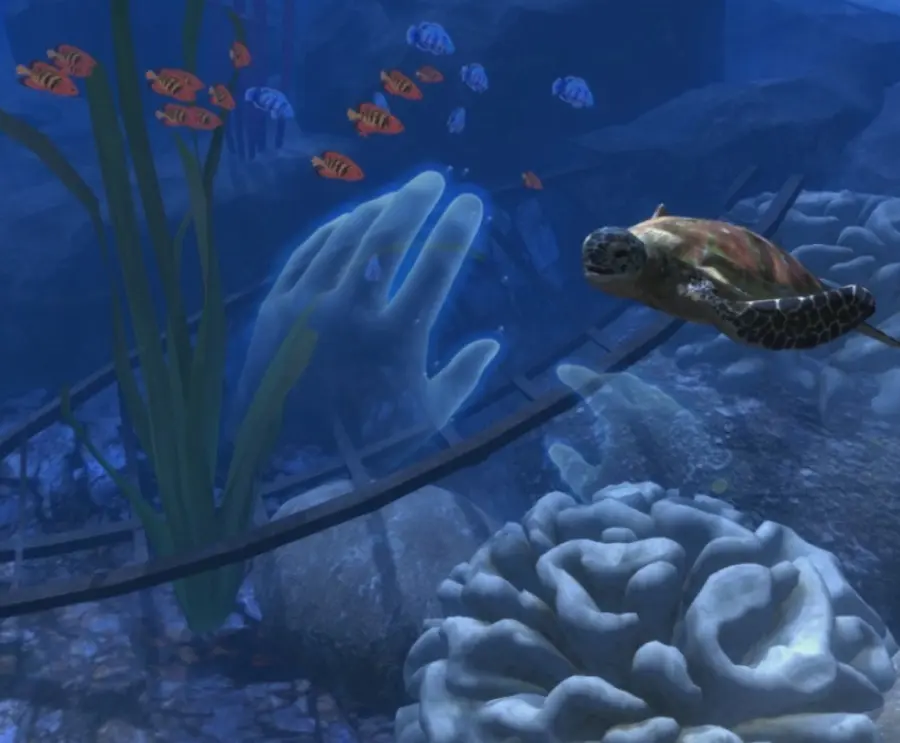
For an ocean-pollution session, learners might begin by predicting how plastic reaches a marine ecosystem, investigate its consequences inside Ocean Quest and finish by explaining one pathway from human action to environmental impact.
8. Choose proportionate evidence
Match the evaluation to the claim. If the objective concerns knowledge, ask learners to explain or apply the concept. If it concerns confidence, awareness or participation, choose an appropriate question or observation and report it accurately.
Evidence might include a short pre- and post-question, a concept map, learner explanation, sorting activity, teacher observation or follow-up task. Report who participated, what they experienced, how the outcome was measured and what the result cannot establish.
9. Understand the complete cost
Compare proposals on more than headset time. Relevant cost factors may include equipment, facilitators, travel, programme preparation, supporting activities, technical setup, evaluation and reporting. Ask what the school must provide and what happens if the timetable, attendance or venue changes.
A useful proposal should make responsibilities and assumptions visible. Where a fixed public price is not appropriate, the provider should still explain how the quotation is constructed.
10. Use a short approval checklist
- Is the learning objective specific and relevant?
- Is the experience appropriate for the intended learners?
- Are meaningful non-headset participation routes available?
- Are the timetable, equipment and staff roles realistic?
- Have space, hygiene, safeguarding and accessibility been planned?
- Does the reflection activity connect experience to understanding?
- Will the evaluation measure the claimed outcome?
- Are responsibilities, cost factors and next steps clear?
Planning Ocean Quest with Neptune’s Submerge
Ocean Quest sessions are shaped around the setting rather than sold as one universal format. Explore the Ocean Quest experience and delivery approach, review our planning for Schools and SEND settings, or examine the contextual evidence in our case studies.
Take this guide into your next planning meeting:
Download the seven-page school decision pack (PDF) ↓