Neptune’s Submerge · Innovation and intellectual property
Beyond the headset.
From interactive ocean education to the next generation of diving simulation.
Our starting point is Ocean Quest VR: an experience already delivered to learners. Our next engineering ambition is ABYSS ONE: a proposed system linking virtual depth, physical feedback and biometric insight. They share a purpose, but they are at different stages of development.
Experience the ocean. Then explore how simulation might feel.
We distinguish a delivered education product from an engineering programme requiring prototype validation.
Available for facilitated delivery
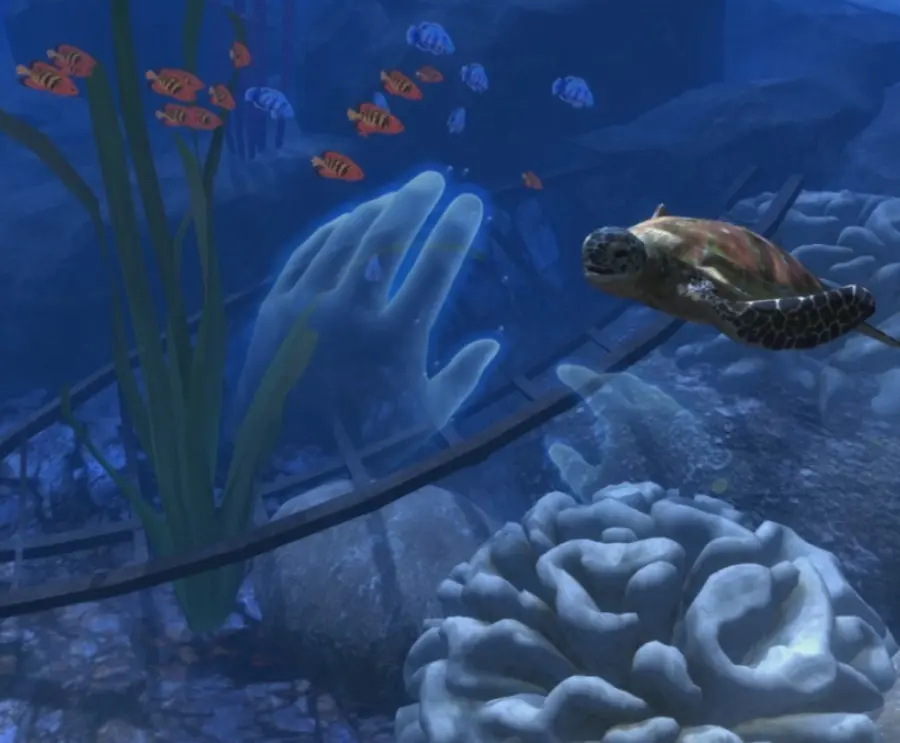
Ocean Quest VR
Interactive marine learning: explore reefs, respond to pollution, help marine life and reflect with an educator. Designed for supported sessions in schools, SEND and wider learning settings.
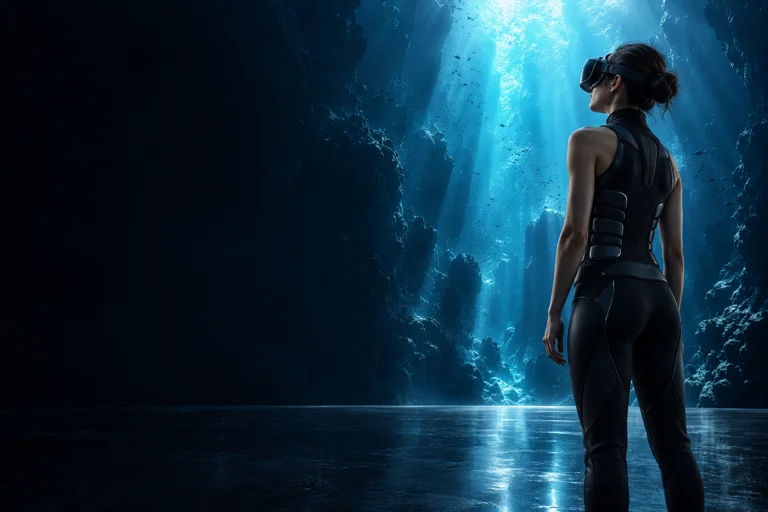
A proposed diving-simulation system combining immersive visual cues, depth-linked compression wearables and biometric monitoring. Integration, feasibility, performance and safety still require engineering and testing.
How to read these figures: The MMU sample size, full questionnaire and response count are not published on this site. The results are self-reported and cannot establish comparative effectiveness or predict outcomes for other learners. The college figure measures reach only.
The proposed physical layer
What changes when a simulator extends beyond the screen?
ABYSS ONE’s development hypothesis brings three systems together. The engineering aim is coordinated cues—not an assertion that external pressure reproduces the full physiology of real diving.
01 / See
Virtual environment
Immersive spatial and visual cues communicate an underwater setting and a simulated change in depth.
02 / Feel
Depth-linked wearable
Proposed inflatable or adjustable elements could change a controlled compression cue in step with the simulated descent.
03 / Observe
Biometric insight
Proposed sensors could relate selected physiological signals to session events, subject to appropriate consent, safety and validation.
Documented intellectual property
Published UK and international patent applications.
Neptune’s Submerge is named as applicant for A diving simulation system: UK publication GB2640439A (22 October 2025), originating from a filing on 18 April 2024, and international publication WO2025219690A1 from PCT/GB2025/050741 (23 October 2025). The published descriptions include a VR environment, biometric sensing and optional pressure-cue wearables.
IP status: These are published applications, not proof of a granted patent, commercial readiness, exclusivity over all VR learning or technical performance. Public patent-register summaries should be checked again during due diligence.
A progression in interaction—not a claim of proven superiority.
Conceptual comparison of media and product features; not an independent competitor benchmark.
Experience format
Learner or user role
Physical feedback
Current status
Conventional 360° marine video
Primarily watches and looks around
Not intrinsic to the format
Established media format
Ocean Quest VR
Explores, interacts and completes guided marine activities
Visual and controller-based interaction; no depth compression
Available for facilitated educational delivery
ABYSS ONE
Would experience a virtual dive with coordinated cues
Depth-linked wearable compression and sensing are proposed
In development; not validated or commercially available
This comparison describes intended functionality. It does not demonstrate better learning, diving competence, wellbeing or safety outcomes. A simulator cannot replace real-water training and qualified diving supervision.
External research · Not studies of our products
Why study immersive marine experiences?
Independent research offers useful questions and cautious signals for our roadmap. None of these studies tested Ocean Quest or ABYSS ONE.
25students · Randomised comparison · 2023
Marine debris education
Joshi and colleagues compared a VR teaching approach with video-based education. Their sample showed greater motivation for action with VR.
Keith and colleagues reported positive self-assessed motivation and knowledge consolidation after a different marine VR experience; these were not independently measured long-term outcomes.
Voşki and colleagues compared screen, dry-land VR and VR used in water. The underwater condition strengthened some responses, but the study found no effect on long-term pro-environmental behaviour.
The underwater-VR trial used a headset while participants were physically immersed in water. This is different from ABYSS ONE’s proposed dry-land compression system; its findings cannot validate that hardware concept.
An evidence-led development journey
Proven delivery. Open questions. A clear next step.
Ocean Quest brings a deliverable immersive learning experience and real pilot feedback. ABYSS ONE brings a published technical concept and an engineering agenda. The next milestone is credible integrated-prototype evidence—developed with the right technical, research and commercial partners.